
Índice do Artigo
You finish that last row, sew up the seams, and slip on your new cardigan—then realize something’s off. The shoulders might sag, or maybe the sleeves feel tight and awkward.
Every crocheter has that moment of letdown after hours spent with yarn in hand. The good news is, you can usually fix these sizing issues by changing your hook size or adjusting your stitch tension.
Even if your cardigan is already complete, blocking or reworking a few seams can make a huge difference. The trick, though, is to catch problems before you even start your first chain.
Nearly every size issue with a crochet cardigan can be fixed by going up or down one hook size. This one adjustment solves about 70% to 80% of fit problems, and you don’t have to fight against your own natural tension.
If you only notice the problem after finishing, blocking or reworking small sections can still save your project. But the real key is prevention—making a proper gauge swatch is what keeps headaches away in the first place.
Does Changing My Hook Size Actually Work?
Switching your hook up or down a size really does solve most sizing problems in crochet. If your cardigan turns out tighter than the pattern says, the fastest fix is to use a bigger hook. For example, moving from a G-6 (4.0 mm) hook to an H-8 (5.0 mm) immediately gives your stitches more space and makes the fabric looser.
If your cardigan feels floppy, stretched, or just too big, do the reverse and drop your hook size. This approach lets your tools do the hard work, so you don’t have to change how you naturally crochet. It keeps things comfortable and consistent, and you won’t wear out your hands trying to force tighter stitches.
Most worsted-weight cardigan patterns suggest an H-8 or I-9 hook, and small adjustments in this range make a noticeable difference. You don’t need to switch to an extreme size—tiny changes are often all it takes to get the fit just right.
Important tip: Before you commit to a new hook size, make a quick swatch with your main yarn and stitch. This five-minute step can save you hours of frustration later, and you’ll see right away how the hook affects your fabric.
How Can I Check My Gauge Before I Start?
Skipping the gauge swatch is the most common error I see, and it’s almost always the reason a cardigan turns out the wrong size. The right way is to crochet a generous swatch—at least 6×6 inches (15×15 cm), but 8×8 inches (20×20 cm) is even better—using the main stitch from your pattern.
A tiny swatch hides minor differences, while a bigger one tells you exactly how your fabric will behave.
After making your swatch, wash and block it just like you would with the finished cardigan. Blocking isn’t optional here; it’s how you see the yarn’s true stretch and shape. Some fibers loosen, others shrink, and you want to know this before making your whole cardigan.
Once the swatch is dry, take a ruler and measure the center (edges can be misleading). Count how many stitches and rows fit into 4 inches (10 cm), both across and up.
Compare these numbers to your pattern’s gauge. If you have more stitches than required, your tension is tight, so go up a hook size.
If you have fewer, your stitches are loose, so go down a size.
This might sound tedious, but it will save you time and wasted yarn. I’ve learned the hard way that skipping the swatch almost always means having to rip out and redo a huge chunk of work. Now, I always start with a swatch, and it saves me plenty of headaches.
Quick summary: Crochet your gauge swatch in the main stitch, block it the same way you’ll treat the finished cardigan, measure in the center, and check against the pattern numbers. Only start your cardigan when your swatch matches up—this habit makes all the difference for fit.
What If My Cardigan Is Already Too Big or Too Small?
It’s tough when you finish a cardigan and realize it’s the wrong size. But that doesn’t mean your work is wasted.
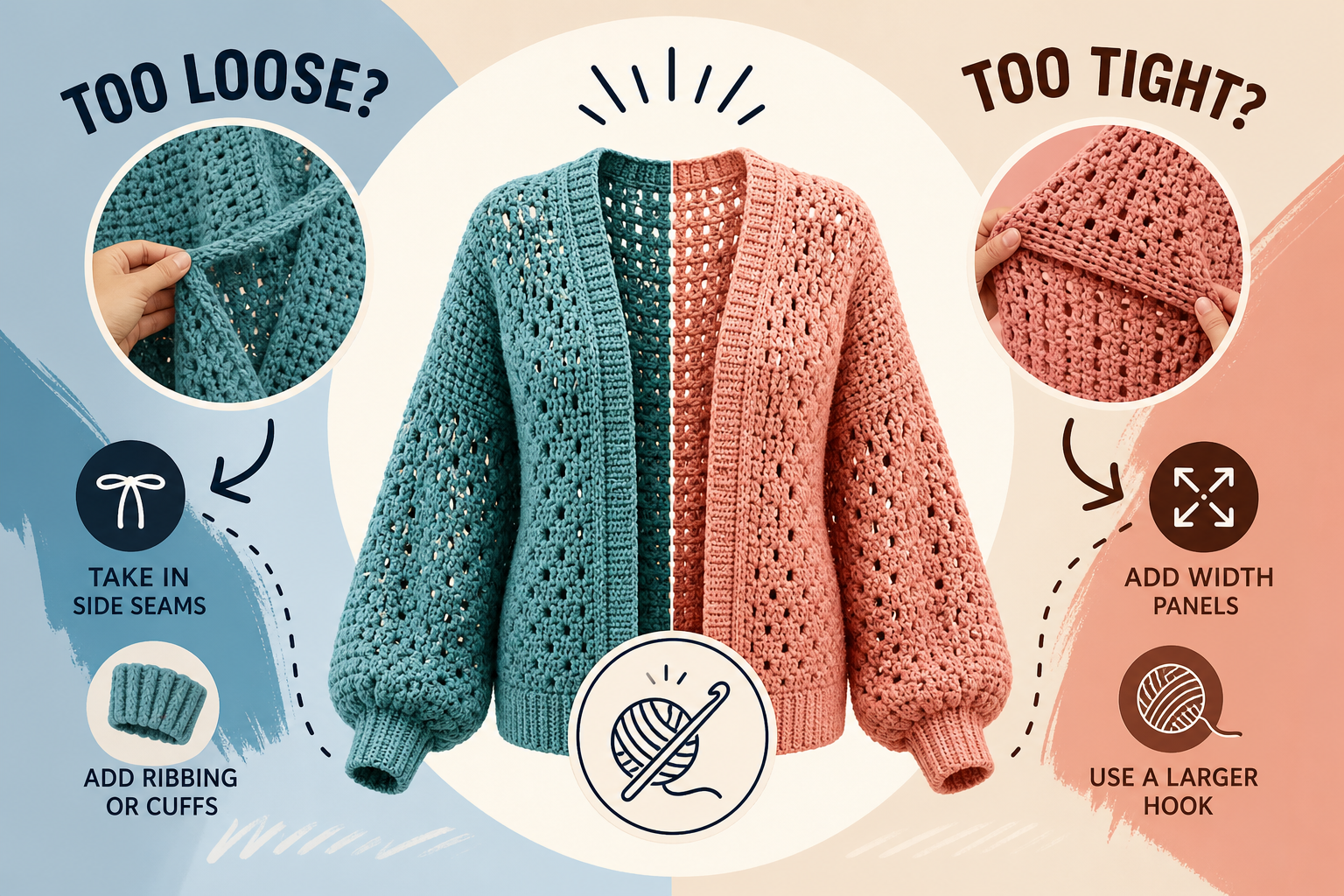
If your finished piece is too loose, try blocking it. Wash it in lukewarm water, gently squeeze out the extra, then lay it flat and shape it to the right size.
Natural fibers like cotton or wool often shrink a little and firm up with blocking.
If your cardigan is just a bit too large, adjusting the seams can help. Redo the sides or sleeves with a deeper seam to remove excess fabric, while keeping the outside looking neat. Pin the sections first, try it on, and only sew when you’re satisfied with the fit.
For cardigans that are too tight, blocking with a gentle stretch can add an inch or two. Be careful not to overdo it and warp the fabric.
If you need even more room, you can add a crochet panel to the sides, sleeves, or hem. Using simple stitches like single or double crochet keeps the addition subtle and adds a custom touch.
A stiff, heavy cardigan usually means your hook was too small. For future projects or if you’re reworking parts, go up to a bigger hook—say, 11 mm or 12 mm—for a looser, lighter drape.
Important tip: Always try blocking before undoing any stitches. It’s surprising how often blocking alone can fix fit issues and save you from starting over.
Why Does My Tension Change, and What Can I Do About It?
Uneven tension is a challenge for many crocheters, especially on big projects like cardigans. I’ve noticed my stitches get tighter if I crochet late at night or when I’m stressed, and looser when I’m relaxed. This back-and-forth can make the fabric look bumpy or uneven.
Focus on how you hold your yarn. Tension isn’t about pulling tightly; it’s about relaxed control.
If your hands or wrists hurt, or if the hook keeps snagging, you’re likely gripping too hard. The yarn should move easily, with just enough hold to keep your stitches uniform.
Taking frequent breaks, shifting your position, or even switching your seat can help keep your hands loose. I often use a yarn bowl so the skein spins freely and doesn’t tangle, which really smooths out the process. Another habit is to check my stitch size every few rows—if I see a change, I stop and fix it right away before the problem gets bigger.
I’ve learned that crocheting in a hurry almost always leads to uneven tension. That’s why I set aside quiet time for important parts like starting or finishing sleeves. These simple habits keep my cardigans looking even and professional.
Quick summary: Consistent tension comes from relaxed hands and a steady pace. If you spot a difference, slow down and adjust immediately—it’s much easier than fixing it later.
How Can I Avoid Sizing Mistakes Next Time?
Once you’ve fixed a cardigan, you’ll want to avoid the same struggle next time. My top tip is to use stitch markers for the first and last stitch of every row. It may seem like a small thing, but it stops you from adding or missing stitches—those little mistakes can throw off the whole fit.
At the start of each new project, pay close attention to the gauge details and take time for a swatch. Patterns and video tutorials are helpful, but double-checking your own numbers is what actually gets the fit right.
It’s also a good idea to jot down which hook size you’re using and any changes you make. I’ve set projects aside for weeks before, only to forget which hook I started with. One quick note—or even a sticky on your project bag—keeps you organized.
For patterns with shaping, increases, or decreases, stitch markers are even more useful. They help keep your edges straight and make it clear where each section begins and ends, so future adjustments are much simpler.
Important tip: Never underestimate the value of stitch markers and quick notes. These easy habits prevent mistakes and make the whole process smoother, with no fancy tricks needed.
Ready to Fix Your Next Cardigan?
Fixing a crochet cardigan teaches you more than any guide. It proves that every detail, from your first swatch to the last seam, changes the finished piece. Getting a good fit isn’t about luck; it’s about planning ahead, paying attention, and making small tweaks when you notice something off.
For your next project, start with a swatch, use the right hook, and place your markers from the first row. If something feels wrong, try blocking, adjusting seams, or adding panels before pulling out rows of work. These practical steps keep crochet enjoyable and frustration to a minimum.
What’s the trickiest part of adjusting your cardigan’s size for you? Leave your question or share your experience—someone else is probably working through the same problem and looking for answers.